
Original article (Chinese): MiniMax 团队 AMA 揭秘:H3 为何如此出色?!

No weekend grind—just a few casual notes.

This has arguably been the wildest week yet for video generation, and I have been learning everything I can about the field’s techniques and underlying technology.
A few days ago, I came across a Reddit AMA—Ask Me Anything—hosted by MiniMax. Community members could ask the developers whatever they wanted. Several answers covered issues many of us care about, so I organized the most important ones here.

One of the first questions that caught my attention was:
“Will MiniMax continue to open-source its future models?”

Ryan, MiniMax’s head of developer relations, replied:
“Of course! We’ll keep open until AGI comes.”
So we can at least look forward to more—and hopefully better—open models from MiniMax.
Now, back to H3.
One question concerned a visible difference between its generation modes:
Does reference-to-video produce worse image quality than image-to-video?
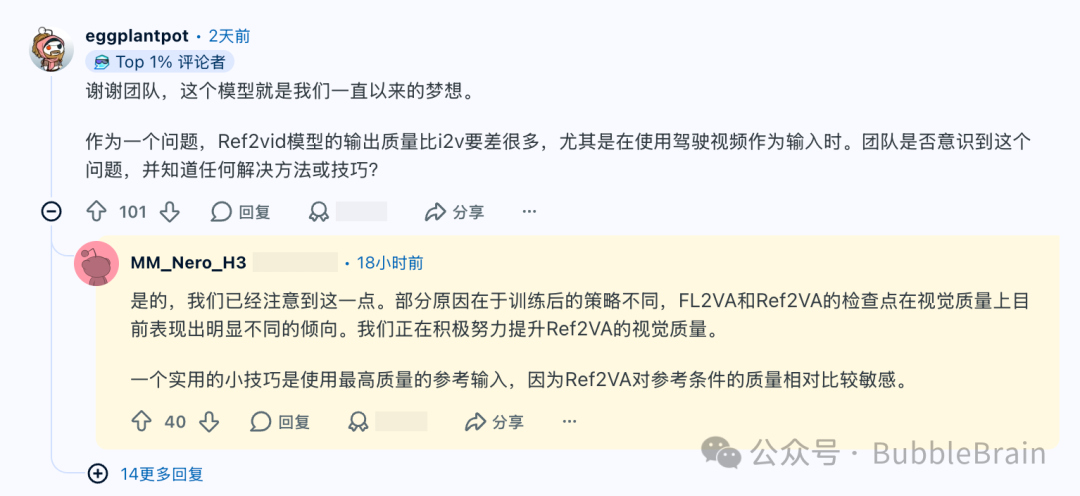
I noticed this myself when testing H3. My first reference-to-video generations did not look as good as I expected.
MiniMax researcher Nero confirmed that the difference is real and said the team is working to improve reference-to-video quality.
The quality gap comes from different post-training strategies.
Image-to-video and reference-to-video use separate checkpoints, and the two exhibit different visual tendencies.
Nero also offered a practical tip: use the highest-quality reference inputs available, because this mode is especially sensitive to the quality of its conditioning material.
Another question drew a lot of interest:
Will MiniMax release the model used to generate the final 2K output?

Ryan said:
There is no confirmed date yet, but the model will be released.
Some context helps explain why this matters. The version previously available on MiniMax’s website could produce 2K video, but the current open-source release cannot. More importantly, the 2K result is not created with conventional super-resolution.
Think of traditional super-resolution as enlarging a 768p picture and guessing the missing detail along the way. The problem is that it can only repair or decorate what is already there. If the original frame contains an error, the high-resolution version will preserve that error.
MiniMax takes a different approach:
Its 2K output is produced through regeneration.
The second stage treats the first-stage draft as reference context, then runs the entire generation process again from scratch at 2K resolution.

This 2K regeneration model appeared to be the topic the community cared about most. MiniMax researcher Kiro added that it is a dedicated DiT model operating in latent space.
The key distinction is that super-resolution enlarges an image and guesses details, while regeneration creates the image again. That can produce more coherent and realistic detail—and can even repair small flaws from the first-stage output.
Another interesting question asked whether H3’s sparse attention reused the MSA architecture from M3.
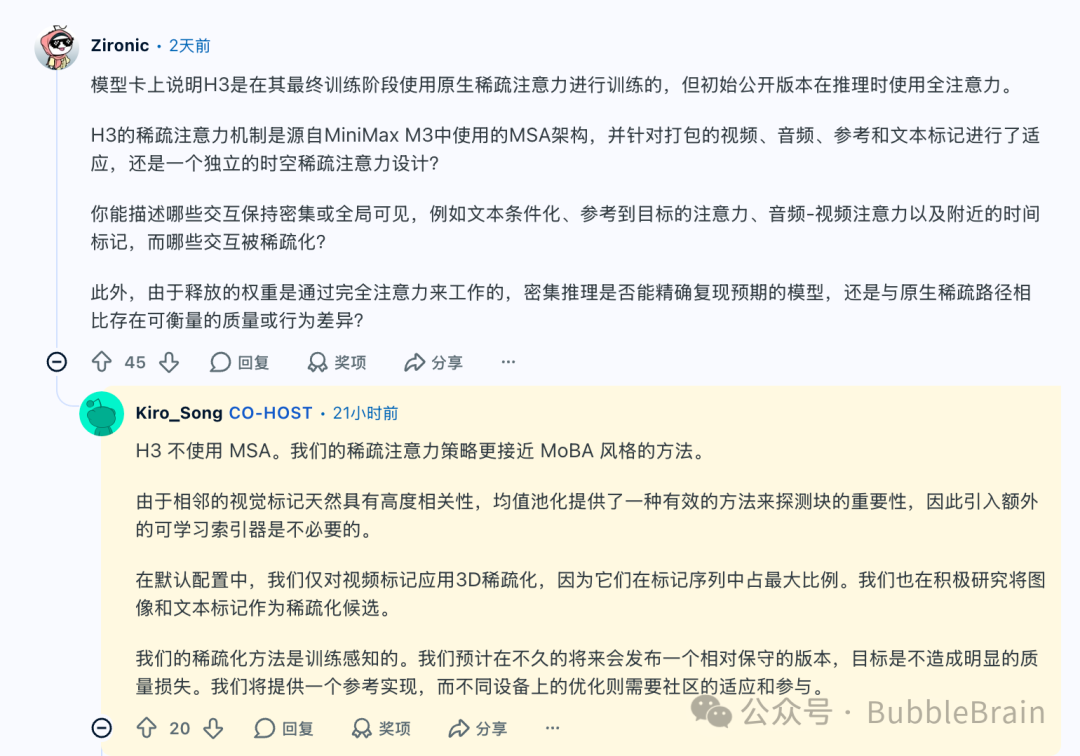
Kiro explained:
H3 does not use M3’s MSA sparse-attention architecture; its design is closer to MoBA.
Attention is one of the most computationally expensive parts of both video generation and text generation. A 15-second video is divided into an enormous number of tokens. With standard attention, every token interacts with every other token, so the amount of computation explodes as the sequence grows.
Sparse attention avoids making every token interact with every other token. It groups tokens into blocks, quickly summarizes those blocks, computes attention for the important ones, and skips the rest.
H3’s cleverness lies in how it selects those blocks. According to Kiro, adjacent video frames are already highly similar, so taking the average of each block is enough to represent it. That removes the need for a separately learned indexer.
The team currently sparsifies only the video tokens, which make up the overwhelming majority of the sequence. They expect to release a relatively conservative version in the near future.
The community also asked whether MiniMax would consider a faster, low-step version of H3.
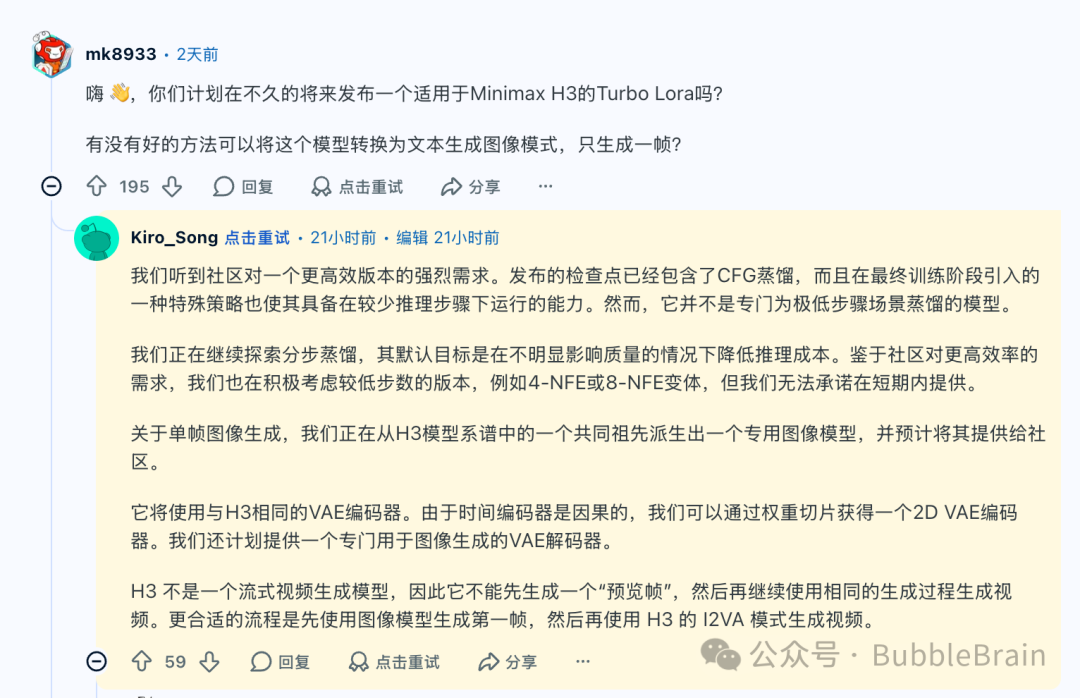
MiniMax said that the current model already includes some acceleration, although it was not designed specifically to trade an acceptable amount of visual quality for faster inference. The team is actively considering a low-step version but did not make a concrete commitment.
Interestingly, the community has already created a four-step variant.

I found a fast version from the LightX2V team on Hugging Face. It is indeed faster, but its image quality drops and the audio can break down. That helps explain why the official team still describes low-step H3 as an area of exploration.
Another answer worth watching:
MiniMax really is planning to release an image-generation model.
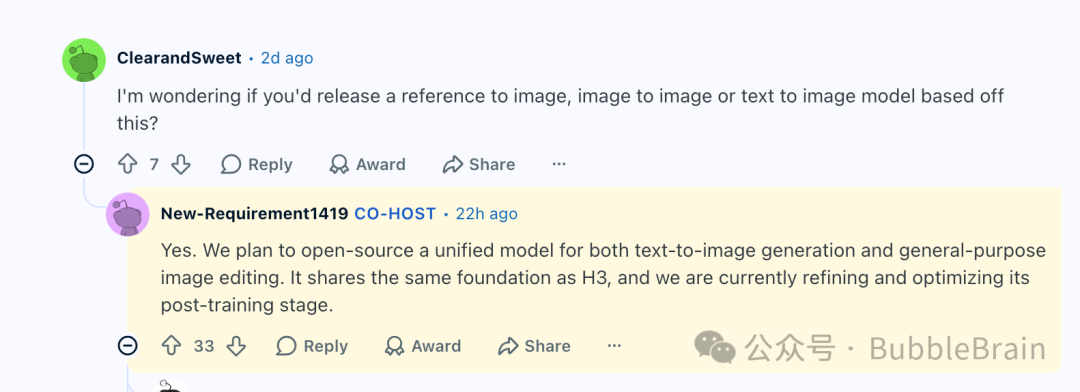
The image model shares H3’s foundation and is designed as a unified model supporting text-to-image, image editing, and related tasks. It is currently still being optimized in post-training.
One frequently reported H3 issue is:
People and other subjects become blurry in distant shots.
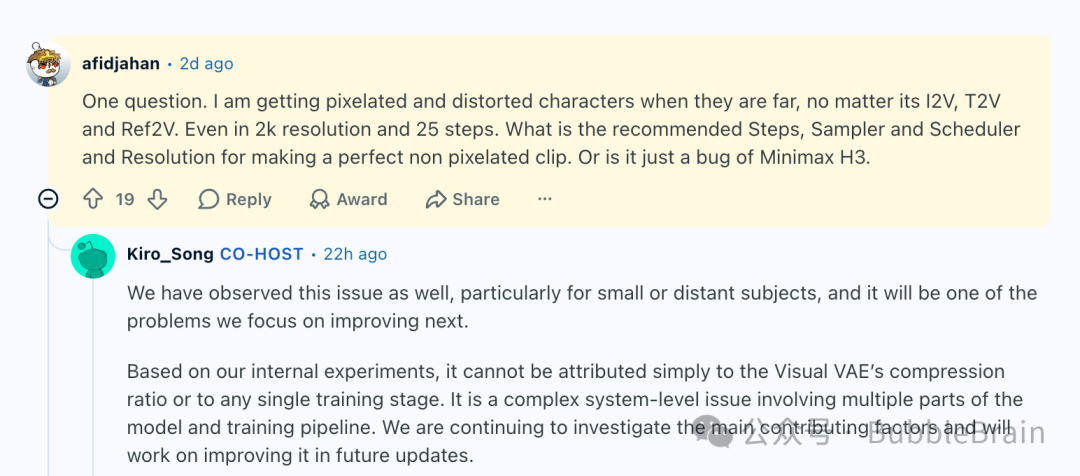
Users have observed that distant content can become pixelated even when generating with 25 steps. One person asked whether a different parameter configuration would help or whether this was simply an H3 limitation.
To MiniMax’s credit, the team answered directly: this is a known model issue, and they are continuing to investigate its cause. At present, it appears to be a complex system-level problem involving multiple models and parts of the training pipeline. We will have to wait for future updates.
Another strength I noticed in my own testing is that:
This generation of H3 follows instructions exceptionally well.
Other users noticed the same thing and asked which part of the system contributed most.
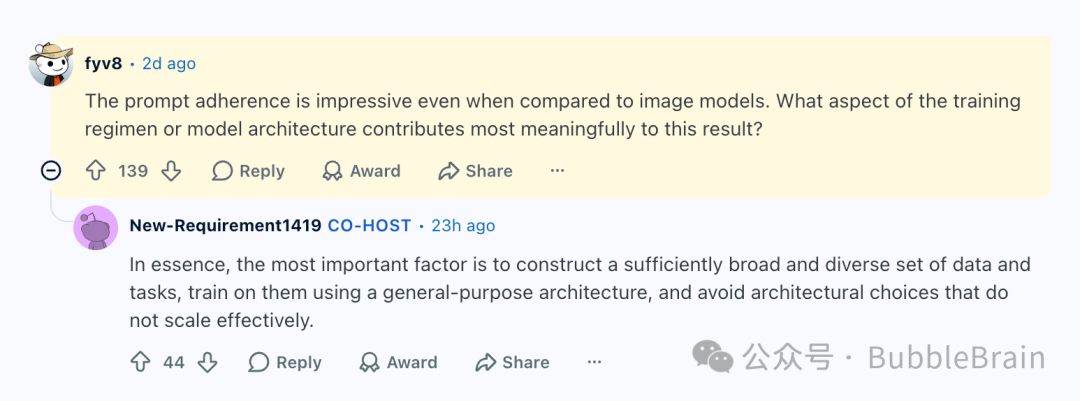
The team’s answer was refreshingly simple:
It is difficult to attribute the result to one component. The core is to build a sufficiently broad and diverse dataset, use a general architecture, and remove anything that does not scale effectively.
In other words, instruction following emerged naturally from the overall system.
From the beginning, H3 was designed to understand context composed of different modalities and generalize across tasks. Judging by its actual performance, that methodology appears to be working.
The final question that stayed with me asked which experiment changed the team’s understanding of what video models are really learning.
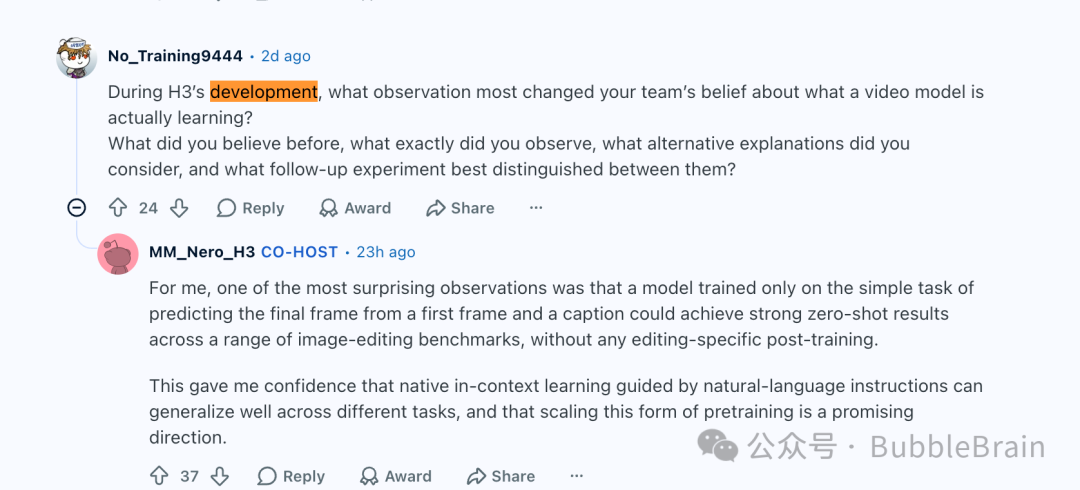
Nero gave a candid answer:
A model trained only to predict the final frame from the first frame plus a text description achieved surprisingly strong zero-shot results across a range of image-editing benchmarks.
That suggests the model had learned to generalize beyond the task it was explicitly trained for. It also gave the team confidence that context learning guided by natural-language instructions can generalize well across different tasks—and that continuing to scale in this direction has real potential.
After reading the full AMA, my main impression is that MiniMax is serious about openness. It is not merely releasing model weights; it is also bringing community feedback into the model’s ongoing development.
That matters enormously in an open-model ecosystem. An open model’s real vitality is not defined only by how impressive it looks on release day. It comes from a continuous cycle:
Developers release a model, the community tests it, users report problems, researchers absorb that feedback, and the next version improves.
In some ways, this process matters more than chasing a single benchmark score.
We still do not know what the final form of video models will look like. But H3 gives us a glimpse of one particularly compelling direction:
Let the model try to genuinely understand this multimodal world.